The HOKA Runaway Sydney Half Marathon is on Sunday 2 May 2027, a 21.1km race from the Cahill Expressway to The Domain. Most runners need about 16 weeks to prepare, which means starting on Monday 11 January. The course is fast but not flat, and its hardest kilometres come late, so hill running in training, backed by strength work that lets you handle more of it, is what holds your pace.
| Key race facts | HOKA Runaway Sydney Half Marathon 2027 |
|---|---|
| Date | Sunday 2 May 2027 |
| Distance | 21.1km, AIMS-certified course |
| Distances on offer | Half marathon only on the 2027 entry page |
| Start | Cahill Expressway, corner of Macquarie and Bridge Streets |
| Finish | Celsius Event Village, The Domain |
| Start times | Start groups from about 6:25am to 9:10am (subject to change) |
| Field size | Nearly 30,000 registered participants in 2026 |
| Cut-off | Three hours from start line closure (12:30pm final cut-off in 2026) |
| Aid stations | Six, with water, electrolytes and toilets |
| Course | Cahill Expressway start, along the harbour and under the Sydney Harbour Bridge, a loop through Pyrmont, past Barangaroo and through the Royal Botanic Garden to finish at The Domain |
| Source | runawaysydneyhalf.com.au, last checked 13 October 2026 |
Which Sydney Half Marathon is this?
This guide is for the HOKA Runaway Sydney Half Marathon, the May race through the Sydney CBD that was known as the Sydney Morning Herald Half Marathon for most of its history, and that plenty of runners now just call the HOKA Half. It is a different event from the Sydney Half Marathon run by Athletics NSW at Sydney Olympic Park in September, and it is not part of the TCS Sydney Marathon weekend in late August.
What is the Sydney Half Marathon course like?
The Sydney Half is fast but not flat. The long middle section around Pyrmont, Darling Harbour and Barangaroo sits close to the water and rewards rhythm, while the hardest work comes between 15km and 18km, when the course leaves the harbour and climbs back up through The Rocks.
Here is how the 2026 course played out, using the kilometre points from the official cut-off table.
The start to 5km. You start on the Cahill Expressway above Circular Quay, head down toward the harbour and cut across the western edge of the CBD to Pyrmont Bridge just before 5km. With tens of thousands of runners going off in waves, these kilometres are crowded, so the job is to settle in rather than chase time.
Pyrmont and Darling Harbour, 5km to 11km. The loop around the Pyrmont peninsula passes Pirrama Park, follows waterside paths and comes back past the Australian National Maritime Museum. It sits at harbour level with short rises and plenty of turns, and this is where your pace should start to feel controlled.
Barangaroo, 11km to 15km. The course runs past Crown and through Barangaroo before joining Hickson Road. It is still close to the water and it is the best stretch on the course to run efficiently, which matters because of what comes next.
The Rocks and the Cahill Expressway, 15km to 18km. From Hickson Road the course climbs through Millers Point and The Rocks, then returns to the Cahill Expressway at about 17.6km. This is the section that decides how your last 3km go, and it is where runners who only trained on flat paths start to lose time.
The Royal Botanic Garden to The Domain, 18km to 21.1km. You drop past Shakespeare Place into the Royal Botanic Garden Sydney, run out along Mrs Macquaries Road to the far turn at about 19km, then head back and up to the finish at The Domain. It rolls the whole way, and the final rise feels far bigger on tired legs than it looks on the map.
Use the elevation profile on the official course map on runawaysydneyhalf.com.au rather than guessing at gradients, and check the 2027 map when it is released, because the finish has moved before and older listings still show Hyde Park.
How long should you train for the Sydney Half Marathon?
Most runners need about 16 weeks, which means starting on Monday 11 January 2027. If you already run consistently and your long run is not far off race distance, 12 weeks starting on 8 February can be enough.
Here is how those 16 weeks fall on the calendar, with the running and strength focus for each phase. Treat it as a guide and adjust it to your running history and how your body handles load.
| Weeks | Dates | Running focus | Strength focus |
|---|---|---|---|
| 1 to 4 | 11 Jan to 7 Feb | Base: easy aerobic volume, consistent weeks, early starts to manage the heat | Foundation strength and plyometrics while running load is modest |
| 5 to 10 | 8 Feb to 21 Mar | Longer long runs, regular hill running, one quality session a week | Heavier, progressive work on calves, quads, glutes and hips |
| 11 to 14 | 22 Mar to 18 Apr | Race-pace work, course-specific long runs with climbs late in the run | Power and speed qualities, total volume starts to come down |
| 15 to 16 | 19 Apr to 2 May | Taper: running volume drops, short sharp sessions keep the legs fresh | Fewer sets, weights stay heavy |
Base, weeks 1 to 4. These weeks build the engine with easy running and give your strength training room to do its job before running load climbs. This is where you build the running base that the 12-week build assumes, and it lands in the hottest part of the year, so run early and let pace drift on hot days.
Build, weeks 5 to 10. Long runs extend, hills become a regular part of the week and one session moves toward quality work. This is where most of the specific hill preparation for the 15km to 18km section happens.
Race-specific, weeks 11 to 14. Training starts to look like the course, with race-pace efforts and long runs that put the climbs in the back half, the way the race does.
Taper, weeks 15 to 16. Running volume comes down and a little intensity keeps your legs sharp, while strength stays in the program at fewer sets.
If you want to start before Christmas, treat December as a base-building block. A few weeks of consistent easy running and getting back into the gym means you arrive at 11 January ready to build, rather than starting from scratch in the heat.
Want the last 12 weeks planned for you? Our Sydney Half cohort starts 8 February for runners with a training base, and is capped at 10 runners. Join the waitlist.
Strength training for the Sydney Half: what each phase needs
Running hills is the most specific preparation for this course. Strength training builds the capacity in your calves, quads, glutes and hips that lets you do more of that hill running, and more weekly volume, without breaking down.
A half marathon is somewhere around 15,000 to 20,000 foot strikes depending on your stride and finish time, and the Sydney course adds climbs and descents on top. Your calves and Achilles tendons do more of the work going up through The Rocks, your quads absorb the braking on the way down into the Royal Botanic Garden, and your glutes and hips keep each stride stable as fatigue builds. If those tissues run out of capacity before you run out of fitness, your form falls apart first and your pace follows.
The gym work follows the running phases. In January we build a foundation of strength and plyometrics while running load is still modest, then through February and March the work gets heavier and more progressive in the areas each runner needs most. From late March the focus shifts to power and holding what you have built, because the hills and race-pace sessions are now doing much of the specific work.
Strength does not get lighter as race day gets closer. We drop the volume and keep the intensity, so a runner who was doing four sets of six through March might be doing two sets of four at a similar weight in the taper. That keeps the capacity you built in January without adding fatigue you will still be carrying on 2 May.
"Strength builds the capacity, but you still have to put it into the thing you want to get better at, which is running the hills on this course. We keep it heavy right through the taper so that capacity is still there on the climb back up to the Cahill Expressway."
Luke Murfitt, Head Coach, Evolve Human Performance
I will not repeat exercise lists here. Start with the top 5 strength exercises for runners and triathletes, then read how much runners should strength train per week to work out where it fits around your running.
Local to the Shire? Two gym sessions a week at our Caringbah gym, built around your run plan. Strength and conditioning at Evolve.
Training through a Sydney summer
The first half of this block lands in January and February, the hottest and most humid weeks of the Sydney year. Heat will slow you down, and a slow run in the heat is the weather talking, not a sign your fitness has gone backwards.
Start early, ideally finishing your long runs before the sun gets high, and choose shaded routes where you can. Run by effort or heart rate rather than pace, because the same easy effort will be noticeably slower on a 30 degree morning than in March, and forcing the pace turns an easy run into a hard one.
Carry fluid on long runs and replace electrolytes as well as water, since you will lose far more sweat than you do in autumn. Use those runs to practise the fuel you plan to use on race day too. By the time 2 May arrives, race morning will feel cool and the work you did in the heat will pay off.
Sutherland Shire routes that match the course
You can prepare for every section of this course without driving into the city. These three routes come from our guide to the 13 best running routes in the Sutherland Shire, which has full distances, elevation and access details.
Lady Carrington Drive, Royal National Park: the harbourside middle
Wide, gently undulating and shaded, Lady Carrington Drive suits long runs that need constant small changes in gradient without steep descents. It is a good match for the Pyrmont and Barangaroo section, and the shade makes it one of the better summer long run options in the Shire.
Burraneer Hill loop: the climb through The Rocks
The back streets of Burraneer have some of the punchiest gradients in the Shire. Use them to practise holding an even effort up short, sharp climbs, and running back down them under control, which is exactly what the 15km to 18km section asks of you.
Kareela, Jannali and Oyster Bay: the finish to The Domain
This loop drops toward the water and climbs back out on longer, steadier rises. Put it at the end of a long run in the race-specific phase to rehearse the rolling run through the Royal Botanic Garden and the final rise to the finish on tired legs.
For flat, measured pace work, Sylvania Waters Athletics Track and the easy running around Caringbah and Cronulla balance out the hill days. Our Saturday track session is there for runners who want structured speed work in a group, and not every run should be hilly, because the flat days are where most of your easy volume and recovery happen.
How to pace the Sydney Half Marathon
Run by effort rather than the watch. Even splits are the wrong target on a course that rolls, so hold a steady effort and let your pace slow on the climbs and quicken on the descents.
Do not go out too fast. The first few kilometres are crowded and full of adrenaline, and weaving around other runners to hold goal pace costs more energy than the seconds are worth. Through the flat harbourside middle, hold back a little more than feels necessary, because this is where most runners bank time they pay for later.
Between 15km and 18km, shorten your stride, keep your cadence up and accept a slower split on the climbs. If you have kept something in reserve, the last 3km through the Royal Botanic Garden is where you race. Most of the running that teaches this kind of control happens at an easy aerobic effort, and our post on Zone 2 training for runners explains what that looks like.
Using the Sydney Half as a Sydney Marathon tune-up
The Sydney Half falls 17 weeks before the TCS Sydney Marathon on 29 August 2027, which makes it a well-timed tune-up if you are running both. It sits early in the marathon build, so it gives you a race-effort check and a hit of race-day practice without disrupting the bigger block.
Decide early whether it is a race or a hard training day. If you are racing it, a short taper of a few days is usually enough, and strength stays in the week at fewer sets. Afterwards, most runners need a week or more of easy running before quality sessions return, depending on how hard they raced and how the body pulls up.
Our Sydney Marathon training guide covers the full block from here to race day, and our post on what changes in training from the half to the full marathon explains how the week shifts once you step up.
First half marathon? What to expect
The cut-off is three hours from when the start line closes, and in 2026 the final cut-off at the finish was 12:30pm, with timed checkpoints along the course. Runners start in groups based on predicted finish time, from about 6:25am, and the official advice is to be at the start line 45 minutes before your group goes.
Getting into the CBD is the part first-timers underestimate. Roads close early, public transport is included with your entry and bag drop at The Domain opens at 5am, so plan to arrive well before you think you need to. Collect your bib during race week unless you have paid for postage.
The mistakes we see most are starting in a faster group than your training supports, wearing new shoes or kit on the day and eating a breakfast you have never run on. If you would like someone to plan the block with you, here is what an online run coach actually does.
Five mistakes that cost runners at the Sydney Half
1. Starting too fast. The crowded opening kilometres and race-day adrenaline make it easy to run well above your effort, and the bill arrives between 15km and 18km.
2. Never training on hills. The harbourside middle is quick, but the climb through The Rocks punishes runners whose long runs were all on flat paths.
3. Dropping strength work in the final month. Strength should drop in volume, not disappear, and the weights should stay heavy so the capacity you built is still there on race day.
4. Skipping summer long runs because of the heat. Move them earlier and run them by effort instead, because missing them in January and February leaves a gap you cannot fill in April.
5. Trying new fuel on race day. Whatever you take on course should be something you have already used on long runs, ideally in the heat, where your gut is under the most stress.
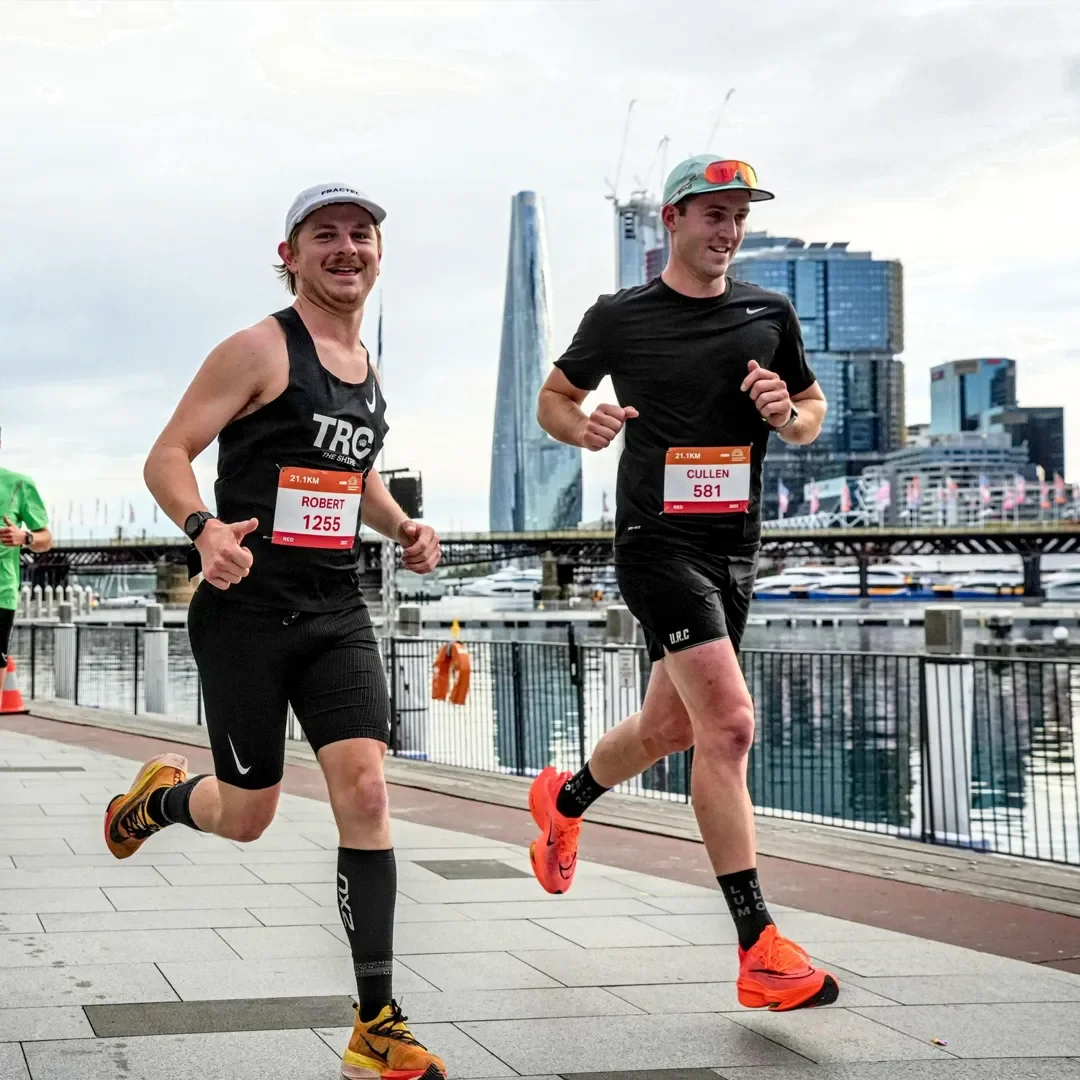
Our very own Coach Riley pacing Josh to a 1:25 half at Hoka Half Marathon 2023.
Train for the Sydney Half with Evolve
There are two ways to train for the Sydney Half with us. If you are local, join our Caringbah cohort: 12 weeks from 8 February, for runners who already have a running base, capped at 10 runners, with two gym sessions a week, individual run coaching, our Saturday track session and testing at the start and end of the block. If you are building from a lower base, start the base phase above in January, or start with online run coaching now and move into the cohort in February.
If you are outside Sydney or prefer to train on your own schedule, our online run coaching works anywhere in Australia, with a program built around your week and a 30-day money-back guarantee. You can meet our coaching team to see who you would be working with.
Join the February cohort waitlist
Sydney Half Marathon Training FAQ’s
When is the 2027 Sydney Half Marathon?
The 2027 HOKA Runaway Sydney Half Marathon is on Sunday 2 May 2027. It starts on the Cahill Expressway in the Sydney CBD and finishes at The Domain, with start groups setting off from about 6:25am. Check the official race website for final start times and the 2027 course map.
How many weeks do I need to train for the Sydney Half Marathon?
Most runners need about 16 weeks, which means starting on Monday 11 January 2027. If you already run consistently and your long run is not far off race distance, 12 weeks from 8 February can work. At Evolve in Caringbah we build the block around your history rather than a fixed template.
Is the Sydney Half Marathon course hilly?
It is undulating rather than hilly. The middle of the course around Pyrmont and Barangaroo sits close to the harbour, but the climb from Hickson Road up through The Rocks to the Cahill Expressway between 15km and 18km, and the rise to the finish at The Domain, catch out runners who only train on the flat.
Is the Sydney Half Marathon good for a PB?
Yes, if you train for the course. It is AIMS-certified, early May mornings in Sydney are usually cool, and the harbourside section suits steady running. The crowded first few kilometres and the late climbs cost time, so start in the right start group and keep something in reserve for the final 3km.
What is the cut-off time for the Sydney Half Marathon?
The half marathon cut-off is three hours from when the start line closes, and in 2026 the final cut-off at the finish was 12:30pm. There are also cut-off points along the course, so check the 2027 times on the official race website and make sure you are in the right start group.
Should I strength train while training for a half marathon?
Yes. Strength training builds the capacity in your calves, quads, glutes and hips that lets you handle more hill running and more weekly volume without breaking down. Build it early in the block, then keep the weights heavy through the taper with fewer sets. We coach this at our Caringbah gym and online.
Can I run the Sydney Half Marathon and the Sydney Marathon in the same year?
Yes. The Sydney Half on 2 May falls 17 weeks before the TCS Sydney Marathon on 29 August 2027, so it works well as a tune-up. Plan it as part of your marathon block rather than a separate peak, and expect to need a week or more of easy running afterwards, depending on how hard you raced.