Training for the Gold Coast Marathon takes about 20 weeks for runners with a solid base, starting Monday 15 February 2027 for the race on Sunday 4 July. The course is flat and fast, so the challenge is holding goal pace for the full 42.2km, which is why race-pace long runs, practised fuelling and consistent training matter most.
The ASICS Gold Coast Marathon has become the race Australian runners pick when they want a marathon PB. It is flat, it starts early on a mild winter morning, and it runs past the beach for most of the way. Time Out Australia reports that more than 60 per cent of runners set a personal best there each year. That reputation is earned, but a flat course asks something different of your body than a hilly one, and plenty of runners who arrive fit still fade badly over the last 10km.
At Evolve Human Performance we coach endurance runners from our gym in Caringbah in the Sutherland Shire and online right across Australia, and we are running a dedicated Gold Coast Marathon block for 2027. This guide pulls together everything we give our own runners: the race facts, how entries work, what the course is really like, a 20-week phase calendar, the strength work that protects your pace late in the race, and the race weekend details people usually scramble for in the final fortnight.
If you are training for Sydney instead, our Sydney Marathon training guide covers a very different, hillier course.
Gold Coast Marathon 2027 key facts
The table below covers what is confirmed for 2027 and what is carried over from 2026 until the organisers publish updated details. Always check the official Gold Coast Marathon website before you book anything.
| Item | ASICS Gold Coast Marathon 2027 |
|---|---|
| Date | Sunday 4 July 2027 (the half marathon, 10km and 5km are on Saturday 3 July) |
| Distance | 42.195km, AIMS certified |
| Start and finish | Race Precinct, Broadwater Parklands, Marine Parade, Southport |
| Start time | 6:15am for the first wave (2026 waves started at 6:15, 6:25, 6:35 and 6:45am) |
| Cut-off | 6 hours 40 minutes, timed from the last wave start |
| Course | Flat coastal out-and-back; the 2027 course map is still to be confirmed |
| Entry | By ballot for 2027: applications open 8 December 2026 and close 8 January 2027, with offers from 19 January |
| Entry fee | $275 for 2027 ($235 in 2026) |
| Qualifying status | Accepted as a Boston Marathon qualifier; qualifying race for the Abbott World Marathon Majors age group rankings (40+) |
| Race day transport | Free G:link light rail for registered runners on race day (2026) |
| Race morning weather | About 14°C at the start and 18°C by 10am, usually humid (average of the last 10 races) |
| Source | goldcoastmarathon.com.au |
How to get a Gold Coast Marathon entry
For the first time, entry to the Gold Coast Marathon is by ballot. The 2025 race sold out for the first time in its history, with 4,900 marathon runners registering in the first hour, and the 2026 marathon sold out in record time, so the organisers have replaced first in, first served with a ballot for the 2027 marathon, half marathon and Gold Coast Double. Ballot applications open on Tuesday 8 December 2026 and close on 8 January 2027, successful applicants start receiving entry offers from 19 January, and the 2027 marathon fee is $275.
That changes how you plan. You no longer need to be online at a set minute, but there is no guarantee of a place either, so apply during the window and wait for the result. The 20-week block starts on 15 February, so most runners will know where they stand before week one, and if your offer arrives later, start the block anyway and adjust once you know. The 10km and 5km on the same weekend are not part of the ballot, with general entries opening on Tuesday 2 February 2027 at 12pm Queensland time.
Other ways in have existed alongside general entry in past years, summarised below using the 2026 details, so check which apply for 2027 once the organisers confirm them. Be careful with private resales. The organisers have warned that scammers become more active once races sell out, so only transfer an entry through the official process.
| Entry pathway | How it works |
|---|---|
| Ballot (2027) | Applications open 8 December 2026 and close 8 January 2027; offers from 19 January |
| Charity place | Guaranteed entry through an official charity partner in exchange for fundraising (minimum $2,000 in 2026) |
| Good for Age | For runners who meet set times in a previous marathon or half marathon; applications closed on 30 January in 2026 |
| Official travel agents | Hold entry allocations bundled with travel packages |
| Gold Coast Marathon Legends | Runners with 10 or more finishes get early access to entries |
| Entry transfer | Only through the organiser's official transfer process, never a private sale |
What the Gold Coast Marathon course is like
The course runs along the narrow coastal strip between the Pacific Ocean and the Broadwater, so there is nowhere for big climbs to come from. The official 2026 elevation profile listed only around 65m of total climbing across the full distance, most of it from gentle rises and road changes rather than real hills. For practical purposes it is flat.
In recent editions the route has started in Southport and headed south along the beachfront through Main Beach, Surfers Paradise, Broadbeach and Mermaid Beach to a southern turn at Miami, which sat at 17.4km in 2025. Runners then come back north through Surfers Paradise and past the Southport precinct before a northern section along the Broadwater through Labrador and Biggera Waters to Runaway Bay, then turn for home to finish at Broadwater Parklands. Burleigh Heads, the old southern turn, has not been used since 2024 because of light rail construction along the Gold Coast Highway.
Two features of the layout matter for your race plan. First, you run close to the finish area well before you are done, which is a mental hit if you are already struggling. Second, the northern section along the Broadwater is quieter than the beachfront, with fewer spectators at the point in the race where you need them most. The 2027 map had not been released at the time of writing, so check the official course page once it is published and look for exactly where the turns and the final northern section fall.
Why a flat marathon is harder than it looks
A flat course removes the hills, but it also removes the natural changes in pace and effort that an undulating course forces on you. On the Gold Coast you can lock onto one pace from the gun and hold it, which is exactly what makes it fast, and exactly what makes it easy to get wrong.
When runners fade badly after 30km here, the cause is usually not mysterious. Most of the time it comes down to some combination of going out faster than their fitness supports, not taking in enough fuel during the race, or arriving without enough specific preparation to hold goal pace for the full distance. A common version of the last one is a block where every long run was easy, so race pace in the back half of a marathon was something the runner had never practised. On a flat course pace is the only variable, so your watch shows every second you lose.
The plan below targets all three: aerobic volume to build the engine, goal pace practised late in long runs so race pace is familiar on tired legs, and a fuelling strategy rehearsed from early in the block. Strength training supports all of it by helping you tolerate the training load, which we cover further down.
How long to train for the Gold Coast Marathon
Most runners with a consistent running base need about 20 weeks of specific preparation. For the 4 July 2027 race that block starts on Monday 15 February and runs to race day. Twenty weeks gives you time to build long runs gradually, let your strength work turn into real capacity, add goal pace work without rushing it and still taper properly. It also leaves room for the week or two that illness, work or travel will almost certainly take from you, without forcing the back half of the block.
If you are not already running consistently, the weeks between now and mid-February matter more than the block itself. Use December to mid-February to build regular, mostly easy running and a strength routine, so that week one of the block is a step up rather than a shock. If this is your first step up from the half marathon, our guide to what changes going from half marathon to marathon training explains where the extra demands come from.
Start practising your race fuelling early, too. Taking in carbohydrate on your longer runs from the base phase onwards, and building the amount gradually, trains your gut to tolerate it, so by the race-specific phase you can rehearse your full race-day plan without stomach problems. The same goes for what you eat before long runs, because a race-morning breakfast at around 4am is part of the plan as well.
Every number in a plan like this depends on where you are starting from. Your training history, your current weekly volume, how your body handles load and how much time you have all shape what each phase should look like, so treat the calendar below as the structure and fill it in around yourself.
| Weeks | Dates | Running focus | Strength focus |
|---|---|---|---|
| Pre-block | Dec 2026 to 14 Feb 2027 | Consistent, mostly easy running; build the habit and a stable weekly routine | General strength and basic plyometrics, up to three sessions a week where your schedule allows |
| 1 to 5 (Base) | 15 Feb to 21 Mar | Easy aerobic volume, gradual long run increases, strides | Foundation strength for calves, quads, glutes and hips; landing and hopping drills |
| 6 to 12 (Build) | 22 Mar to 9 May | Longer long runs, one quality session a week, first goal pace segments | Two sessions a week, heavier and progressive, with plyometrics |
| 13 to 18 (Race-specific) | 10 May to 20 Jun | Goal pace inside long runs, late in the run; race rehearsals at 6:15am | Heavy lifts at lower volume, plus power and speed work |
| 19 to 20 (Taper) | 21 Jun to 4 Jul | Running volume drops, short sharp goal pace work stays in | Fewer sets, loads stay heavy; strength stays in through race week |
Strength training for the Gold Coast Marathon
Because the course is flat, a lot of runners assume strength work matters less for Gold Coast than it does for Sydney. Its main job is the same on either course: building the tissue capacity that lets you handle the running load of a marathon block, so you can string together long runs and bigger weeks without picking up the niggles that cost you training. Consistent training is what makes the difference on race day.
The table below sets out the areas we prioritise and why we train them. Our top five strength exercises for runners cover most of what we use, and if you are unsure how to fit it around your running, read how much runners should strength train per week.
| Area | Why we train it | Example work |
|---|---|---|
| Calves and soleus | They take a large share of the load with every running stride, so building their capacity helps you tolerate more running | Heavy seated and standing calf raises, pogo hops |
| Achilles and foot | Loaded with every stride, so progressively building their tolerance helps you handle the volume of a marathon block | Single-leg hops, skipping, foot and toe strength |
| Quads | Strength and eccentric work build tissue tolerance, which may help you handle bigger weeks and longer runs with fewer niggles | Split squats, step-ups, squats |
| Lateral hip | An important muscle group with several roles through the running gait | Single-leg work, lateral lunges, hip abduction |
In the pre-block and base phase, the goal is building general strength and getting comfortable with jumping, hopping and landing again. Through the build phase, two sessions a week is a sensible target for most runners, with loads progressing and plyometrics building on the jumping and hopping work from the base phase. In the race-specific phase, sessions get heavier and shorter, with power work replacing some of the volume.
Strength does not disappear in the taper. Close to the race, drop the number of sets but keep the lifts heavy and challenging, so you hold onto the capacity you spent months building. If you want this programmed for you, our strength and conditioning coaching is built around endurance athletes.
Long runs and goal pace work
Most of your running across the block should be easy, aerobic running. That is what builds the engine, and it keeps you fresh enough to make the key sessions count. Our post on Zone 2 training for runners explains why easy running needs to feel easy.
Long runs grow gradually through the base and build phases, relative to what you have handled before. There is no single distance everyone needs to reach. What matters is building the time on feet you need without piling up so much fatigue that the rest of your week falls apart, which we cover in is your long run doing more damage than good.
The Gold Coast-specific shift happens in the race-specific phase. Because the course rewards even pacing, the most useful sessions put goal marathon pace inside your long runs, late, when your legs are already tired. Holding a goal pace block in the back half of a long run is the closest you can get to rehearsing kilometres 30 to 40 without racing them. Run some of these on flat ground so the pace and rhythm match race day. The Shire is hilly, but our Sutherland Shire running routes guide includes flatter options that work well for this.
Using the Sydney Half Marathon as a tune-up
The HOKA Runaway Sydney Half Marathon on Sunday 2 May 2027 lands at the end of week 11, roughly nine weeks before the Gold Coast. That timing works well. It is far enough out that you can recover fully and still finish the build, and close enough to give you an honest read on fitness and a realistic marathon goal.
Treat it as a training race rather than a goal race. Ease off for a few days beforehand rather than tapering properly, and expect to take a few easy days after it before getting back into the plan. The course is hillier than the Gold Coast, so judge the result by effort rather than reading your half time straight into a marathon prediction. Our Sydney Half Marathon training guide covers that course in detail.
What race day weather is really like on the Gold Coast
The Gold Coast Marathon is often described as cool, but the race-day record says mild and frequently humid. We pulled hourly modelled weather data for Southport (Open-Meteo historical reanalysis) for the last 10 editions, from 2015 to 2026, leaving out 2020 and 2021 when the race was cancelled.
| Year | 6am temp | 6am humidity | 10am temp | 10am humidity | Wind at 10am |
|---|---|---|---|---|---|
| 2015 | 13.1°C | 100% | 18.0°C | 69% | 5 km/h |
| 2016 | 12.1°C | 88% | 17.6°C | 60% | 3 km/h |
| 2017 | 10.7°C | 79% | 17.8°C | 57% | 8 km/h |
| 2018 | 16.2°C | 93% | 20.0°C | 86% | 3 km/h |
| 2019 | 15.2°C | 89% | 17.2°C | 86% | 17 km/h |
| 2022 | 14.6°C | 92% | 17.2°C | 84% | 3 km/h |
| 2023 | 14.1°C | 66% | 18.7°C | 53% | 20 km/h |
| 2024 | 13.9°C | 78% | 18.0°C | 65% | 18 km/h |
| 2025 | 15.9°C | 81% | 19.0°C | 82% | 4 km/h |
| 2026 | 14.1°C | 73% | 17.6°C | 63% | 16 km/h |
| Average | 14.0°C | 84% | 18.1°C | 71% |
Across those races the start averaged about 14°C with humidity around 84%, and half of them began at 85% or higher. By 10am, when plenty of runners are into their final 10km, it averaged about 18°C and reached 20°C in 2018, and the top temperature for the day ranged from about 19°C to 22°C. Light rain fell in 2019 and 2025, and in 2019, 2023, 2024 and 2026 the wind was blowing at 15 to 20km/h through the morning.
Compare that with what most Sydney runners train in. Using the same data source, a 6am run in Caringbah between June and mid-July over the past five years averaged about 10°C with a dew point around 6.5°C, while race morning on the Gold Coast has averaged 14°C at the start with a dew point around 11°C. If all your long runs happen on cold, dry winter mornings, race day will feel noticeably warmer and stickier, and your heart rate will sit higher at the same pace.
That makes some heat preparation worth considering, as an addition once the core running and strength work is in place rather than a replacement for it. Repeated exposure to heat over the final weeks of the block, through some runs in the warmer part of the day, the odd session in extra layers, or sauna and hot bath sessions after training, gives your body a chance to adapt before race day. If you are already stretched just getting the training done, skip it and focus on the basics.
The block itself starts in mid-February, so the base phase runs through the back end of a Sydney summer before it cools into autumn and winter. Run those early weeks by effort rather than pace. In the race-specific phase, start some long runs at around 6am so your body is used to running well at that hour, and check the forecast in race week so you can tuck in with a group if it is windy.
How to pace the Gold Coast Marathon
The flat course makes even pacing realistic, and it is the strategy that serves most runners best. Aim to run the first half at or very slightly slower than goal pace, settle into a rhythm through the middle, and only push once you have passed 30km and turned for the final stretch. A crowded wave start and fresh, tapered legs make the first 5km feel deceptively easy, which is exactly where PBs get lost.
Use the table below as a guide to even pacing. Times are net (chip) time, which is also what the official pacers run to.
| Goal time | Average pace per km | Even halfway split |
|---|---|---|
| 3:00:00 | 4:16 | 1:30:00 |
| 3:15:00 | 4:37 | 1:37:30 |
| 3:30:00 | 4:59 | 1:45:00 |
| 3:45:00 | 5:20 | 1:52:30 |
| 4:00:00 | 5:41 | 2:00:00 |
| 4:30:00 | 6:24 | 2:15:00 |
| 5:00:00 | 7:07 | 2:30:00 |
| 5:30:00 | 7:49 | 2:45:00 |
| 6:00:00 | 8:32 | 3:00:00 |
The official pacers run to net time and aim to finish about 30 seconds under their target, with at least two pacers per group carrying balloons and goal time signs. Running with a pace group helps with wind and with decision-making late in the race, but know your own pace too in case the group surges or you get separated at a drink station.
Watch for GPS drift through Surfers Paradise, where high-rise buildings can make your watch read fast or slow. Use the kilometre markers to check your pace rather than reacting to sudden jumps on your watch.
Fuelling and hydration on the course
The Gold Coast has plenty of drink stations, with multiple tables at each, and the organisers encourage runners to move past the first table to avoid congestion. In 2026, stations offered water and the official Fixx Nutrition electrolyte, and gels were handed out at 30.5km. Check the 2027 runner guide for exact products and locations once it is released.
Build on the gut training you started in the base phase by rehearsing your full fuelling plan in long runs, using the exact gels and drinks you will race with, at the timing you plan to use. On warmer, more humid race mornings your fluid needs go up too, so practise drinking as well as fuelling. On a flat course it is easy to fall into a rhythm and forget to fuel, so tie your intake to time or distance rather than how you feel. If you plan to use on-course products, buy them early and train with them so race day holds no surprises.
Race weekend logistics: getting there and race morning
Most Sydney runners fly into Gold Coast Airport at Coolangatta, at the southern end of the city, so allow time to travel north to Southport. Staying close to the G:link light rail line is the easiest option, because registered runners rode it free on race day in 2026, getting off at Southern Broadwater Parklands station. Shuttle buses and boat transfers also ran in 2026.
Accommodation goes quickly, so book as soon as you receive your ballot offer. Arrive at least a day or two before the race so you can collect your race number at the expo, walk the start area and keep your normal routine. Start only in the zone printed on your race number, since starting in a faster zone than allocated can lead to disqualification, and leave time to use the bag drop. The 2026 race morning timeline below is a good guide until the 2027 times are confirmed.
| Time | Race morning (2026) |
|---|---|
| 3:30am | Roads along the course close |
| 4:00am | Free G:link services start for registered runners |
| 4:30am | Shuttle buses start from Broadbeach South and Surfers Paradise |
| 5:15am | Recommended arrival at the Southport race precinct |
| 6:05am | Be in your start zone |
| 6:15am | Wave 1 starts (Seeded, Priority and Zone A) |
| 6:25am | Wave 2 starts (Zone B) |
| 6:35am | Wave 3 starts (Zone C) |
| 6:45am | Wave 4 starts (Zones D and E) |
| 1:25pm | Course closes, 6 hours 40 minutes after the last wave |
Running the Gold Coast Double
The Gold Coast Double combines the half marathon on Saturday with the marathon on Sunday for a total of 63.3km and an extra medal, and for 2027 it is entered through the same ballot. It is a great challenge, but it is not a PB strategy for the marathon. If you enter the Double, run the half at a controlled effort and treat the full as the main event, and build some back-to-back long runs into your race-specific phase so your legs know what running on fatigued tissue feels like.
Is the Gold Coast a good first marathon?
For most first-timers, yes. The course is flat, the weather is usually mild, the crowds are large through the beachfront sections, and the 6 hour 40 minute cut-off works out to an average of roughly 9 minutes 29 seconds per kilometre from the last wave start, which gives plenty of room for walk breaks. Pace groups cover a wide range of finish times as well.
The main thing to plan for is the size of the event. Big fields mean crowded early kilometres, queues at toilets and the bag drop, and plenty of race-morning noise. Arrive early, stick with the routine you practised, and set a conservative first goal of finishing strong rather than chasing a time you have never run.
Five mistakes that cost runners at the Gold Coast Marathon
Most bad days at the Gold Coast come from the same handful of errors, and all of them are avoidable.
| Mistake | Why it costs you | What to do instead |
|---|---|---|
| Going out too fast | Flat roads, fresh legs and a big crowd make early pace feel easy, and seconds banked early cost far more after 30km | Run the first half at or just under goal pace and only push after 30km |
| Dropping strength because the course is flat | Strength work is what lets you tolerate the running load of a marathon block, and that does not change because the course is flat | Keep lifting through the block and into the taper, with fewer sets close to race day |
| Never practising goal pace on tired legs | Kilometres 30 to 40 become a new experience on race day | Put goal pace blocks late in your long runs during the race-specific phase |
| Untested fuel and gear | New gels, shoes or breakfast are a common cause of a bad day | Race with exactly what you rehearsed in long runs |
| Leaving travel late | Entries, flights and accommodation all go quickly | Book as soon as you have your entry so race week is about resting |
How Evolve coaches Gold Coast Marathon runners
If you are training from anywhere in Australia, our online run coaching builds your Gold Coast block around your history, your schedule and your goal time. Every week is planned in TrainingPeaks and adjusted to how training is going, with strength programming included and direct access to your coach. If you have not worked with an online coach before, here is what an online run coach actually does.
If you are in the Sutherland Shire, we are also running a local Gold Coast Marathon cohort from our Caringbah gym, following the 20-week block above from 15 February. It combines your individual running plan with group track sessions and strength training at the gym, with groups capped at 10 runners per coach. You can meet the coaching team or get in touch to register your interest.
Either way, the earlier you start, the more of this plan you can use. Start your Gold Coast Marathon block and we will build it around you.
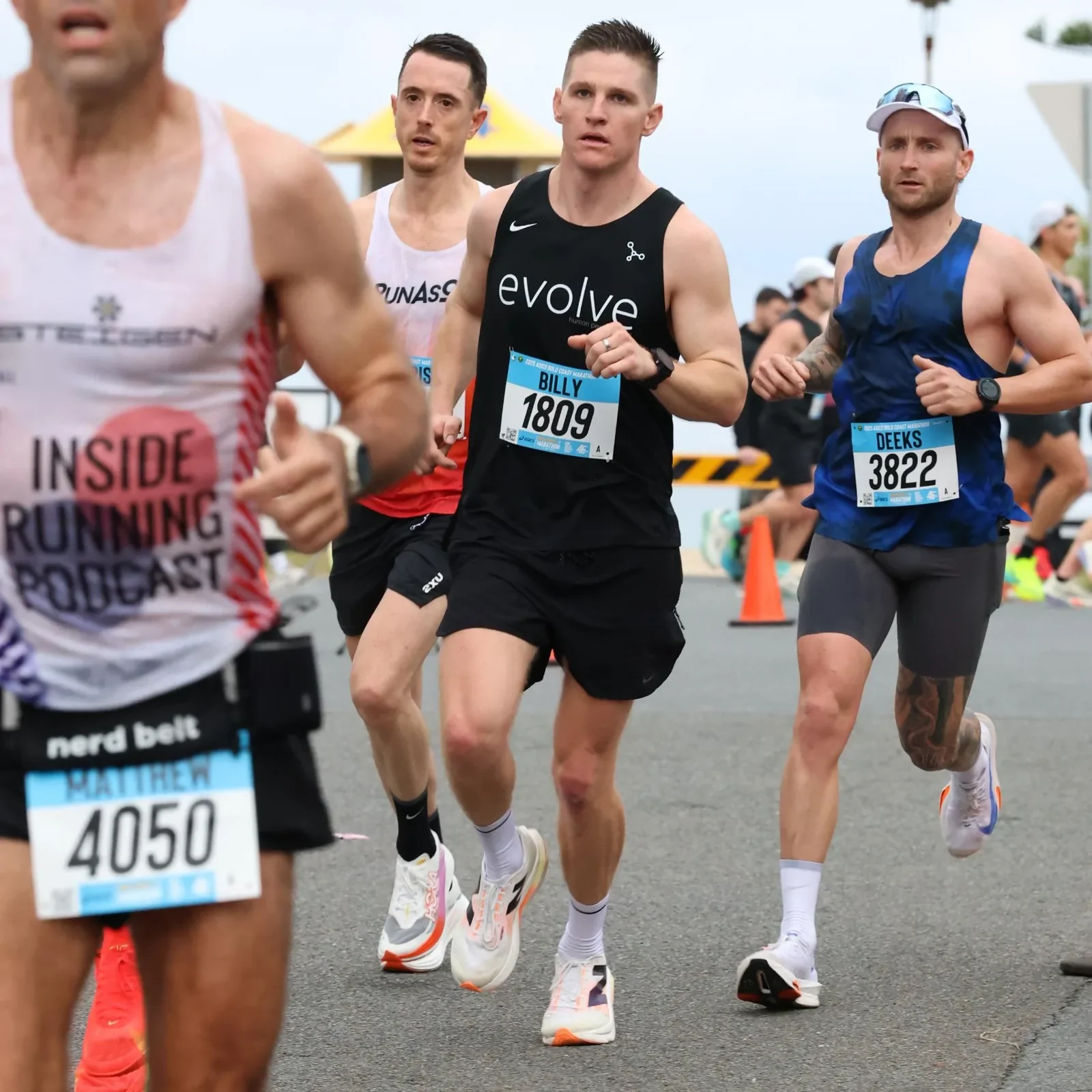
Billy hitting a debut marathon of 2:49 at Gold Coast Marathon 2025.
Gold Coast Marathon Training FAQs
When is the 2027 Gold Coast Marathon?
The 2027 ASICS Gold Coast Marathon is on Sunday 4 July 2027, starting at 6:15am from Broadwater Parklands in Southport. The half marathon, 10km and 5km events are on Saturday 3 July.
Is the Gold Coast Marathon a ballot?
Yes. From 2027 the Gold Coast Marathon, half marathon and Gold Coast Double are entered by ballot, replacing the first in, first served system used in previous years after recent races sold out within hours. The 10km, 5km and wheelchair races are not part of the ballot.
When does the Gold Coast Marathon ballot open?
The 2027 ballot opens on Tuesday 8 December 2026 and closes on 8 January 2027. The ballot is designed to give every applicant an equal chance of a place, so you do not need to apply the moment it opens, as long as you apply before it closes.
When do you find out if you got into the Gold Coast Marathon ballot?
Successful applicants start receiving entry offers from 19 January 2027, and the 2027 marathon entry fee is $275. If you miss out, other pathways such as charity places have been available in past years, so check the official website for what applies in 2027.
Is the Gold Coast Marathon course flat?
Yes. The course runs along the coast between the ocean and the Broadwater, and the official 2026 elevation profile listed only around 65m of total climbing over 42.2km. The challenge is pacing and fuelling well enough to hold an even pace for the whole race, rather than handling hills.
How many weeks do I need to train for the Gold Coast Marathon?
Most runners with a consistent base need about 20 weeks, which means starting on Monday 15 February 2027. If you are not running regularly yet, use the months before that to build consistent easy running and a strength routine first.
What is the cut-off time for the Gold Coast Marathon?
The cut-off is 6 hours 40 minutes, timed from the last wave start. That works out to an average of roughly 9 minutes 29 seconds per kilometre, which leaves room for walk breaks.
What is the weather like for the Gold Coast Marathon?
Race morning is usually mild and often humid. Across the last 10 races the start averaged about 14°C with humidity around 84%, rising to about 18°C by 10am, so it can feel noticeably warmer and stickier than a Sydney winter training run. Wind along the coast is the other variable to check in race week.
Is the Gold Coast Marathon good for a first marathon?
It is one of the best options in Australia for a first marathon. The course is flat, July mornings are usually mild, crowd support is strong along the beachfront and there are pace groups across a wide range of finish times.
Is the Gold Coast Marathon a Boston qualifier?
Yes. The course is AIMS certified, so finish times can be used as Boston Marathon qualifying times. It is also a qualifying race for the Abbott World Marathon Majors age group rankings for runners aged 40 and over.
Can I get coached for the Gold Coast Marathon from Sydney?
Yes. Evolve Human Performance coaches Gold Coast Marathon runners online anywhere in Australia, and runs a local Gold Coast Marathon cohort from its Caringbah gym in the Sutherland Shire, with strength training built into both options.