Why New Runners Shouldn’t Just Run More Pt.2 | Building The Chassis
In Part 1 we covered how to build aerobic volume without overloading your running. The short version: your cardiovascular system adapts faster than your tendons, tissues and bones, so adding off-feet cardio like cycling lets you build fitness at a rate your body can actually handle.
But building the engine is only half the equation. If you only run easy and top up your aerobic volume with low-impact cardio, you are developing your cardiovascular system without fully preparing your chassis for the demands of running. Eventually the chassis becomes the limiting factor, not the engine.
So how do you build the chassis? And how do you do it without just running more?
The Engine and the Chassis Are Two Different Things
Your heart adapts fast. Give it consistent aerobic work and it responds relatively quickly, with improved stroke volume, better oxygen delivery and a lower resting heart rate. The cardiovascular adaptations from training are well established and they happen on a timeline most runners can feel within weeks.
Your tendons, ligaments, bones and connective tissues adapt slowly. The biology is different. These structures have limited blood supply compared to muscle, which means the turnover of new tissue is much slower. A tendon that is being progressively loaded takes months to meaningfully adapt, not weeks. This is why Achilles and patellar tendon injuries are so common in new runners who increase their load faster than their tissues can handle.
The mistake most new runners make is treating these two systems as the same thing. They train their engine through running and assume the chassis is keeping up. It often is not, and the feedback usually comes in the form of a niggle that turns into an injury.
What Actually Builds Tissue Capacity
Tissue capacity is the ability of your tendons, bones and connective tissues to absorb and recover from load. It comes from progressive mechanical stress. The key word is progressive. Your tissues respond to load by getting stronger, more resilient and better adapted to the specific demands being placed on them. But the load needs to be sufficient to create an adaptation signal, and it needs to be applied progressively so the tissue has time to respond before the next loading bout.
Easy running provides a relatively dull mechanical stimulus to your tissues. You are loading them, but not with enough intensity to drive meaningful structural adaptation in a new runner. The stimulus your tissues get from heavy strength training, plyometrics, hill running and faster efforts is a lot more potent. This is the kind of loading that builds a genuinely robust chassis.
The options for building tissue capacity through progressive load include:
Heavy strength training. Compound movements like squats, deadlifts, single leg Romanian deadlifts and calf raises place substantial load on the tendons and connective tissues of the lower limb. Done progressively over months, this is one of the most effective ways to build a chassis that can handle increasing running loads.
Plyometrics. Hopping, bounding, jump rope and simple jump variations develop the elastic properties of your tendons specifically. Running is fundamentally a plyometric activity. You are loading and releasing energy through your tendons with every stride. Training that quality directly makes you more resilient and more efficient.
Hill running. Running uphill increases the load on your calves, achilles and glutes significantly compared to flat running at the same effort. Done in short, controlled efforts it provides a potent tissue stimulus without the same injury risk as flat speed work.
Strides and faster efforts. Short accelerations of 20 to 30 seconds at a controlled fast pace develop the elastic and structural properties of your running-specific tissues in a way that easy running simply cannot.
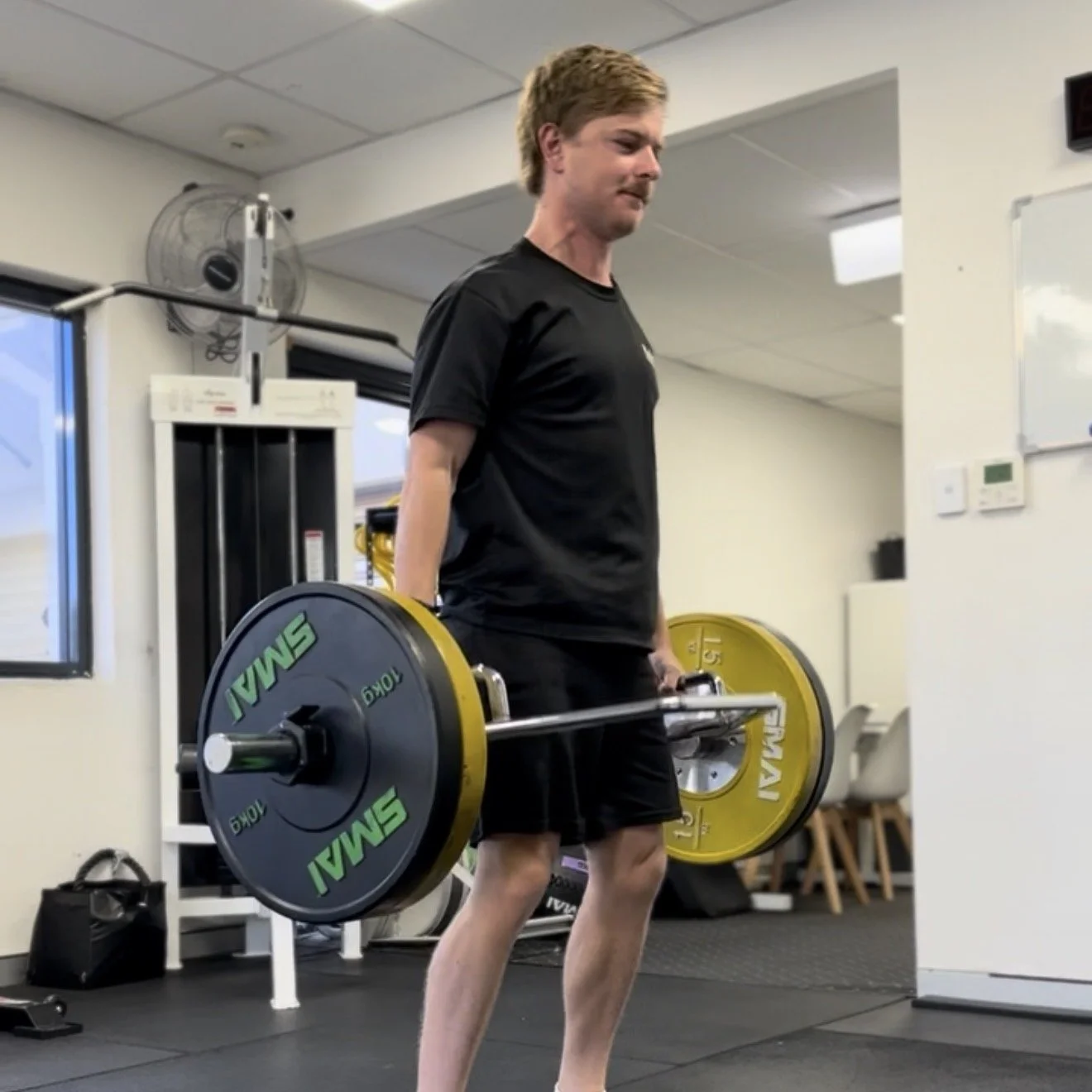
Coach Riley lifting heavy!
The Equation That Determines Your Injury Risk
Understanding how these elements interact makes the whole picture much clearer. Potent stimulus plus adequate recovery equals adaptation. That is the outcome you are chasing.
But if recovery is suboptimal through poor sleep, poor nutrition or too much total load, the same potent stimulus that would otherwise build tissue instead breaks it down. And if you are simultaneously pushing hard on your running volume while also adding heavy strength work and plyometrics, you are stacking two potent stressors on the same tissues without giving either enough recovery time to drive adaptation.
This is why the sequencing matters. For a new runner, the smartest approach is conservative running progression combined with potent tissue work and aerobic top-up through cycling. The running load stays manageable, the tissue stimulus is high enough to drive real adaptation, and the cycling fills the aerobic gap without adding mechanical stress. Stack those three things together with decent recovery and you get a runner who is progressing quickly while actually becoming more robust over time, not less.
Why Most Runners Do Not Do This
The honest answer is that most runners just want to run. Strength training feels like a distraction from the goal. Plyometrics feel foreign. Cycling feels like cheating. The instinct is to just get out the door and add kilometres.
That instinct is not wrong. Running is the goal, and you do need to run to become a better runner. But the runners who stay healthy and improve consistently are almost never the ones who just run more. They are the ones who treat their body as a system with multiple components that all need attention, and they build their training around developing all of those components simultaneously rather than just hammering the one they enjoy most.
The pattern we see repeatedly with new runners who do not address the chassis is predictable. Mileage builds, a niggle appears, training gets disrupted, fitness stalls, frustration sets in. The injury usually gets blamed on bad luck or overtraining when the real cause is undertrained tissues that were never given a reason to adapt.
You Are Playing the Cards You Have Been Dealt
One thing worth acknowledging is that your baseline tissue tolerance is largely determined by factors outside your control. Your genetics, your training history, your age, your body composition and yes, who your parents are all influence how quickly your tissues adapt and how much load they can handle before breaking down. Some runners can do enormous mileage on minimal strength work and stay healthy. Most cannot, and there is no shame in that.
What you can control is how intelligently you build on whatever baseline you have. Playing the cards you have been dealt well means understanding your limiting factors and training around them rather than ignoring them until they become injuries.
For most new runners that means being patient with running progressions, adding potent tissue stimulus through strength and plyometric work, and using aerobic cross training to build fitness faster than running alone would allow. Build the engine and the chassis simultaneously and you give yourself the best chance of tolerating the training you need to hit your goals.
What This Looks Like in Practice
A practical weekly structure for a new runner applying these principles might look like this:
Three easy runs per week at conservative volume, with progressions kept to 10% per week maximum.
Two strength sessions per week focused on lower body compound movements and single leg work including squats, RDLs, calf raises and hip hinging patterns.
Two cycling sessions per week at easy to moderate effort to build aerobic volume without adding running load.
Strides once per week at the end of an easy run, 4 to 6 x 20 second accelerations to develop tissue elasticity and running economy.
That structure gives you meaningful aerobic development, potent tissue stimulus and manageable running load simultaneously. The specifics will vary depending on your current fitness, your goals and how your body is responding. But the principle holds regardless of the details. Build both systems together, not just the one you can feel improving.
Once you've got a plan for building your aerobic base, the next question is where to actually run it. Here are thirteen routes across the Sutherland Shire sorted by distance and terrain.
Want a program that builds both?
This is exactly the approach we take with runners on our online run coaching program, building the engine and the chassis simultaneously so you can train consistently and reach your goals without constantly managing niggles. We also work with runners specifically on strength and conditioning if you want the gym side of this built out properly alongside your running. Based anywhere in Australia, get in touch here.